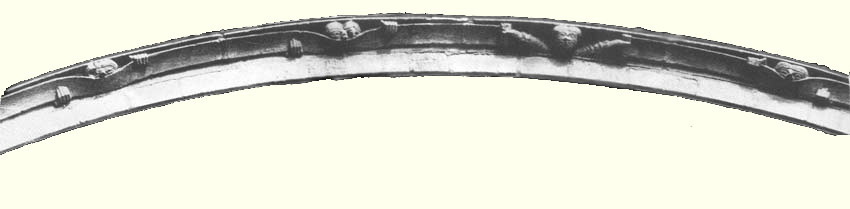
The angels roll up the sky like a parchment
Description and interpretation of the tympanum of Conques by Pierre Seguret
1. INTRODUCTION: the main theme
The common sense classifies Conques’ Romanesque tympanum (Aveyron, France) among Last Judgements. This is Doomsday, the End of Time. Here comes the Apocalypse. The Greek term apocalypse (Αποκάλυψις) literally means Revelation (αποκάλυψε). The tympanum of Conques will reveal the Last Ends before our eyes.
Several signs depict this apocalypse:
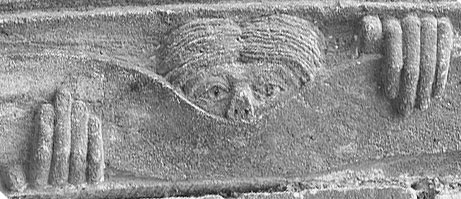
- Above the tympanum, on the Archivolt, 17 Cherubs wrap around the Firmament and reveal the Scene. This is an illustration of John’s Apocalypse: “the Sky disappeared like a scroll that is rolled up.” (Rev 6:14) These 17 “inquisitive onlookers" raise the curtain and we may watch the show!
The angels roll up the sky like a parchment |
 |
 |
|
- Then, two angels sound their trumpets to announce the Judgment. (From now on, the tympanum is inspired by the gospel of Saint Matthew, the second source of inspiration for the Last Judgments)
 |
 |
|
“And he will send his angels with a loud trumpet call, and they will gather his elect” (Mt 24:31) |
||
| Strange celestial signs are appearing: |
||
- Then will appear the sign of the Son of Man in heaven. (Mt 24: 30) Une immense croix apparaît alors dans le ciel : c'est « le signe du Fils de l'Homme » annoncé par Matthieu.
|
||
| - Two angels unfurl a banner around Christ repeating the verses of Saint Matthew about the Last Judgment: | ||
 |
||
<VENITE BENEDICT>I PATRIS MEI POSSIDETE <REGNVM QVOD> VO<BIS PARATVM EST> |
||
A TIME JUST BEFORE THE END OF TIME: THE PAROUSIA (CHRIST'S RETURN AT THE END OF TIME) The specific moment depicted on the tympanum needs to be defined more precisely. The scene portrayed is not exactly the Last Judgment, but rather the Parousia—that is, the Second Coming of Christ. The composition of the tympanum incorporates all these characteristics:
|
 The cinematic sequence of the resurrection of the dead |
|
 The triumphant return of Christ of the Parousia |
 The Adventus of a Roman Emperor |
|
| This staging of the triumphant return of Christ is in every way faithful to the description of the parousia according to the 12th century theologian Honorius Augustodunensis: “Just as when the emperor enters a city, his crown and other insignia of power are carried before him so that his 'adventus' is known to all, so when Christ returns for judgment, angels carrying the cross will precede him". (Honorius Augustodunensis) Let us witness the parade of this great imperial procession announced to the sound of trumpets: |
||
| - Two angels carry the glorious Cross like a trophy; |  |
|
| - Christ Judge and King (JVDEX REX) girded with the magistrates' belt and dressed in the paludamentum, the imperial mantle; |  |
|
| - Two ceroferal angels carry the candles that light the world; |  |
|
| - The thuriferous angel carries the censer; |  |
|
| - The soldier of the victorious army, armed with a sword and a shield, repels the forces of evil; |  |
|
| - The gonfalon angel brandishes the standard of victory; |  |
|
| - The register where the fate of each person is recorded: SIGNATVR LIBER VITӔ (the Book of Life is sealed); |  |
|
| - Finally, the long procession of the vanquished, prisoners of Tartarus. |  |
|
| They are all there. Even the grotesque histrions (or satirical jesters dressed in fringed loincloths) who mock and taunt the defeated captives. | ||
 |
 |
 |
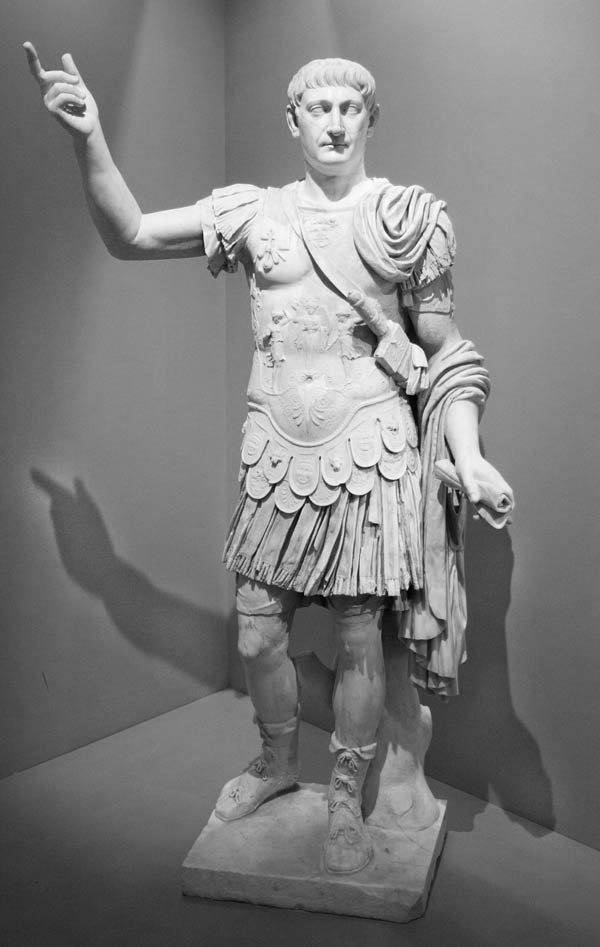
Another example of Roman cultural influence is the gesture of Christ—with his right arm pointing toward the heavens—which recalls the salute of Roman emperors. |
||
 Traditio Legis, tomb of the companions of Saint Ursula, Chapel of Isarn, crypt of Saint-Victor Abbey |
||
- In the end, following the procession, pilgrims pass under the triumphal arch of the Conques portal. The tympanum celebrates the triumph of the Church, conceived shortly after 1100 and the capture of Jerusalem, that means a time when the Parousia was believed to be imminent.
|
 |
|
| So the Conques tympanum does not exactly represent the Last Judgment but rather a Parousia. And yet, it is indeed about a judgment. So, what exactly is it? This is what we'll see in the second chapter: the monks' project. | ||
Last upgrade : August 13th 2026